
 |
|---|


Sixty×Hundred
シックスティー×ハンドレッド
古い映画からサンプリングしたビジュアルを無慈悲に切り出し、組み合わせ、1枚の絵画を生み出す。100年以上も前にリュミエール兄弟が発明した、この古臭く拘束されるコンテンツは、未だ進化の歩みをゆるやかにしながら世界中を飛び回る。
しかし、時たま、あのフカフカの椅子に座りポップコーンを食べながら思うのだ、もはや絵画と純粋に対峙する時間はこの劇場にしか残されていないのではないかと。
パブリックドメインの古い映画からサンプリングされた本シリーズは、動画をjpg=1コマづつの画像データとしてダウンロードする作業からスタートされます。ベースのコマ(ビジュアル)に対し、その他前後の異なる様々なコマが60本差し込まれることで、1枚の絵画に動画に元々あった動きがオーバーラップするように見えます。これはベースの空間に60進歩、つまり時間軸が重なる事で、時間と空間を1つの物質に収めるイメージから発想しました。動画から静止画切り出したビジュアルが、組み合わせた作品よりまた時間という要素を持ち、平面作品という一つの物体で存在する。この様に時間と空間をテーマにして制作されたシリーズです。映画そのものや演者に作家自身の思い入れやストーリーはなく、上記のコンセプトに沿って美しく構成できる動きやビジュアル要素のみを重視し選択されています。サンプリングアートとは無慈悲にコピー&ペースト、再構築される事が核であると、私は考えています。
From old films, the artist unflinchingly snips visuals through sampling, melding them together to birth a solitary canvas. This content, steeped in antiquity and constraints, traces back over a century to the Lumière Brothers' invention, and now circles the globe in its evolving journey. Yet, every now and then, seated in that plush chair, crunching popcorn, the artist contemplates whether the cinema is the last enclave where a pure confrontation with painting endures.
Initiating with the meticulous downloading of video frames as individual jpg images from public domain films of yesteryears, this series embarks on its trajectory. Anchored in a base frame – the visual nucleus – the artist interlaces a series of diverse frames before and after, weaving a composition of sixty frames. This process weaves into the painting a semblance of the original video's motion, inducing an overlap of movement on a static canvas. This concept emanates from the notion of merging time and space into a singular entity, where sixty steps mark temporal convergence, uniting time and space within one material image.
Images carved from the video's flow acquire a dimension of time, in contrast to the combined composition. They harbor the essence of time within the realm of a two-dimensional artwork. Thus, this series is meticulously crafted with time and space as its thematic core. It's important to note that the films themselves, as well as the sentiments and stories of their performers, hold no place in the artist's narrative. Instead, the focus is on harmoniously assembling motion and visual elements aligned with the aforementioned concept. In this sense, the artist believes that the crux of sampling art lies in its merciless copy-paste and relentless reconstruction.
 |
|---|


Mug shot
マグショット
古典主義をレップしつつも、自然に向けた眼を表層から解き放つ。視覚以上のさらに奥の世界、もしくはそれを捉える人類自体の内面を導き出す。解剖学、数学由来の幾何学を利用したキュビズムはコラージュの祖でもあると言える。
何故このメディアを選択したのか?
無慈悲なカットペースト法が生まれながらにして存在する時代の私には、このビジュアルの構成による美の計算式で、先人に敬意を払いながら検算を繰り返す責任があるのだと思う。
アメリカなどで逮捕された時に撮影されることで有名なマグショットのビジュアルをインターネットより引用した本シリーズは、同一人物の正面写真と横顔写真をランダムに組み合わせることで構成されています。他のシリーズ説明でもあるように私にとってコラージュメディアの選択、そして自身のアートワークの核は無慈悲にカットアンドペーストし、ただ美しい構成を導き出すことにあります。
絵画の進化でもあり、コラージュ手法の祖とも評論されているキュビズム。20世紀初頭の美術運動、その技法は解剖学を利用して身体=自然物の内なる構造や要素を導き出したり、多次元など概念で人間の捉える世界そのものを拡張してきたと評されています。
本作はそのオマージュというより、おのずと受け継がれた延長上にある私なりの現代表現だと考えています。美しいビジュアル構成の自分なりの計算式と共に、世界に浮遊するデジタルデータを、布のような構造物で小さな空間の繰り返し、次元をフィジカルに内服させる事で作品は形成されています。
While representing classical ideals, I unleash a gaze towards nature from the surface. Beyond the visual realm lies a deeper world, or perhaps the innermost aspects of humanity that capture it. Cubism, utilizing anatomy and geometry derived from mathematics, can be considered the progenitor of collage. Why did I choose this medium? In an era where the merciless cut-and-paste method is born inherently, I believe there is a responsibility to repeatedly verify and pay homage to predecessors through the beauty equation derived from the composition of this visual art.
This series, which references the visually distinctive mugshots famously captured upon arrest in countries like the United States, is composed of front-facing and profile photos of the same individual randomly combined. As described in the explanation of other series, the choice of collage as a medium and the essence of my artwork lie in the ruthless cut-and-paste approach, solely aiming to derive a beautiful composition. Also, it represents an evolution in painting and is critiqued as the precursor to collage techniques—Cubism. A major art movement in the early 20th century, Cubism utilized anatomy to extract the internal structures and elements of the body-nature, expanding the world perceived by humans through concepts like multidimensionality. Rather than an homage, this work is my contemporary expression naturally inherited and extended from that tradition. Alongside my personal formula for crafting visually pleasing compositions, the artwork takes shape by physically internalizing the floating digital data in the world. This involves the repetition of small spaces within fabric-like structures, administering dimensions to the physical realm.
 |
|---|
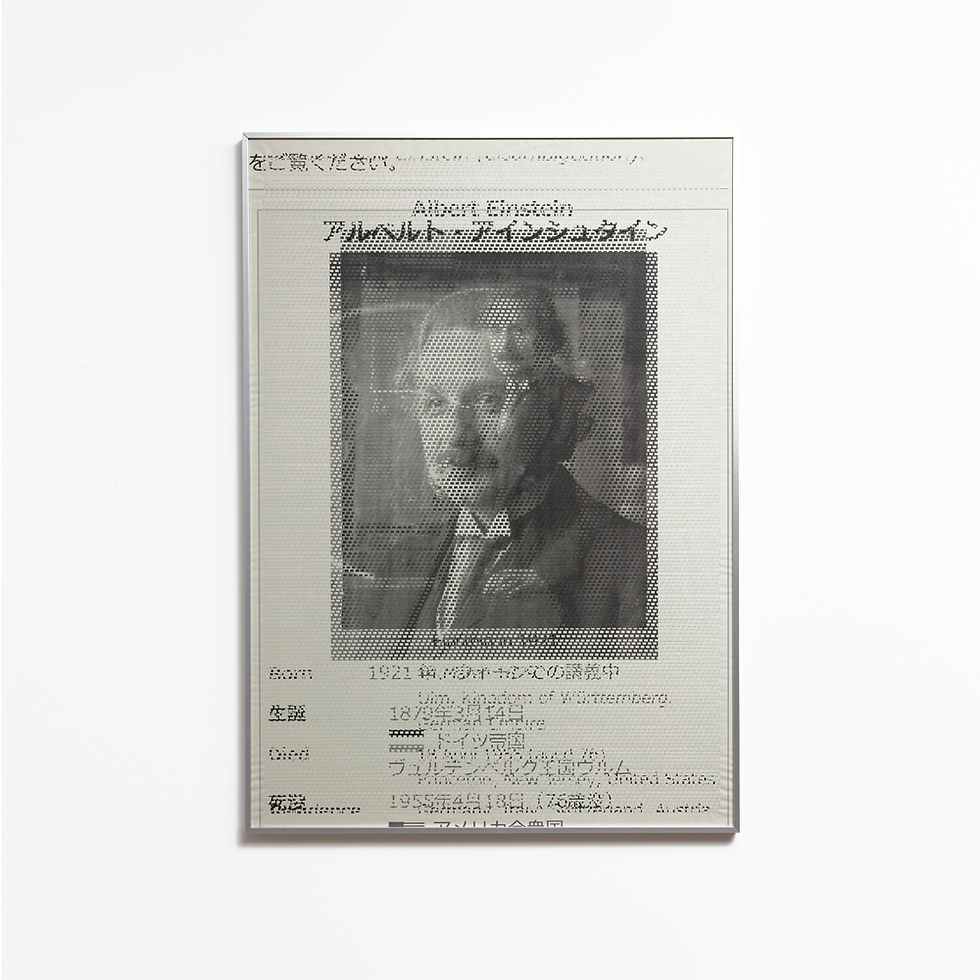


New Portrait
ニューポートレート
デジタル情報ツールの進化により文化がフラット化される世の中でも、ドメスティックな言葉の綾はまだ変わらない。
汚く下品であろうとも、その時代の空気を写し取るラップのリリックの様に、未だ各々の言語の骨格は重なるようでズレ続ける。
それがアイデンティティーか否か?それを言語外で私は組み立てたかった。
パブリックドメインであるWikipediaの画像をサンプリングした本作品は、高度な情報共有ツールによる、世界の文化がフラット化と、同時に矛盾するようにどうしても重ならない骨格、言語の仕組みによる行動や心理の違いを意識ながら、普段使い馴染みのあるデジタルツールを利用して制作しました。
ベースの紙にはWikipediaの日本語ページを印刷、その上にタブを変えた英語ページのビジュアルのパーツ差し込まれています。同一人物でありながら、言語によって写真データが違う場合があり、また似たように見えても言語によってページデザインが微妙に違うことを利用して、先述の社会事象をビジュアルアート化しています。Wikipediaの人物そのものに作家自身の思い入れやストーリーはなく、上記のコンセプトに沿って美しく構成できるビジュアル要素のみを重視し、選択されています。
Even in a world where cultures are flattened by the evolution of digital information tools, the nuanced rhythms of domestic language persist. Like the lyrics of rap, which, despite being raw and vulgar, capture the essence of the times, the skeletal structures of individual languages seem to overlap yet continue to diverge.
Is that the essence of identity? I wanted to construct that beyond language.
This artwork, sampled from images on Wikipedia, which is in the public domain, is created using familiar digital tools while being conscious of the paradoxical nature of the world's cultures flattening through advanced information-sharing tools, yet having skeletal structures, languages, and behavioral and psychological differences that stubbornly do not overlap.
The base paper is printed with Wikipedia's Japanese page, and on top of that, visual elements from English pages with altered tabs are inserted. Despite being the same individual, there are cases where the photographic data differs based on the language, and leveraging the subtle differences in page design depending on the language that may appear similar, the aforementioned societal phenomena are transformed into visual art. The artist does not have any personal attachment or story to the individuals on Wikipedia; the emphasis is solely on the visually appealing elements that can be beautifully arranged in line with the above concept.
 |
|---|


Beat Tape
ビートテープ
ブレイクビーツ思想の核は
サンプリングによりループした配列が時間軸を飛び越え、楽譜から解き放たれたこと。
スコア一冊を材料にカット&ペースト。非情に再構成される楽音が1枚、
それでも拭えない元ネタのソースがもう1枚に。
本作は古本のスコアブック1冊づつを素材にして制作されたコラージュ作品です。下部には1冊つまり1曲から探し出した、同様の音符の配列が4つ並んで組み合わせ、細かな横糸でつなぎ合わせループを構成しています。
一方上部には表紙と中表紙の2枚を端的に、大雑把に組み合わせ構成。HIPHOPの誕生とされるブレイクビーツは既存レコードの間奏部分のドラムビートを繰り返して(ループ)物理的にも概念的にも時間をコントロールする事を特徴とします。そのメソッドをヒントにHIPHOPのトラックのように、4小節ループを繰り返した作品パーツ下部にサンプリング元(元ネタ)を上部の作品パーツにビジュアルアートとして変換されます。
The core of the breakbeat philosophy lies in the transcending of the time axis through sampled, looped sequences, liberated from the constraints of traditional musical scores. Utilizing a single score as material, it undergoes a ruthless cut-and-paste transformation. The ruthlessly reconstructed musical sound is one layer, while the source, which cannot be completely erased, remains as another.
This artwork is a collage piece created using individual secondhand scorebooks as materials. At the bottom, arrays of similar musical notes extracted from a single scorebook, representing one song each, are combined in sets of four and interconnected with fine cross threads to create a looping structure.
On the other hand, at the top, the cover and inner cover of two scorebooks are straightforwardly and roughly combined. Breakbeats, considered the birth of HIPHOP, are characterized by repeating (looping) the drum beats in the interlude of existing records, controlling time both physically and conceptually. Inspired by this method, the sampled source (original material) from the bottom section, repeating a 4-bar loop like a HIPHOP track, is visually transformed into the top section as a piece of visual art.
 |
|---|


Cyanotype
サイアノタイプ
空間と時間は絶対的な存在である。社会を見渡せば一見そう思う。
サイアノタイプの感光作業は非情だ、その場の光量と感光時間の長さ、物理法則に従って物質化する。
しかし毎回あらわれる個性豊かな青い像達の表情を見ていると愛らしくて、そんな事はどーでも良くなってしまう。
サイアノタイプ(cyanotype)は、青写真、日光写真ともいい、鉄塩の化学反応を利用した写真・複写技法(非銀塩写真の一種)で、光の明暗が青色の濃淡として写るためこう呼ばれています。ネガフィルムなどの原稿と感光紙を重ねて露光し、光を透さない黒い部分が感光剤の変化を抑えることを利用し、潜像します。一昔前は建築図面の青焼きとしても有名です。
本シリーズは様々なルールで限定された作業で、サイアノタイプで紙に焼き付けたビジュアルを使用した素材で制作されています。
Space and time are absolute entities. At first glance, it may seem so when surveying society. The cyanotype photosensitive process is relentless; it materializes based on the amount of light and the duration of photosensitivity at the scene, adhering to the laws of physics. However, when gazing at the unique and charming expressions of the blue images that appear each time, such technicalities become inconsequential.
Cyanotype, also known as blueprints or sun prints, is a photographic and printing technique that utilizes the chemical reaction of iron salts, belonging to the category of non-silver photography. It is called cyanotype because the variation in light and shade is captured as shades of blue. The process involves exposing a negative film or other original onto photosensitive paper. During exposure, dark areas that block light suppress the change in the photosensitive agent, creating a latent image. In the past, it was well-known for reproducing architectural drawings as blueprints.
This series is created using materials featuring visuals exposed onto paper through the cyanotype process, a technique limited by various rules and conventions.